
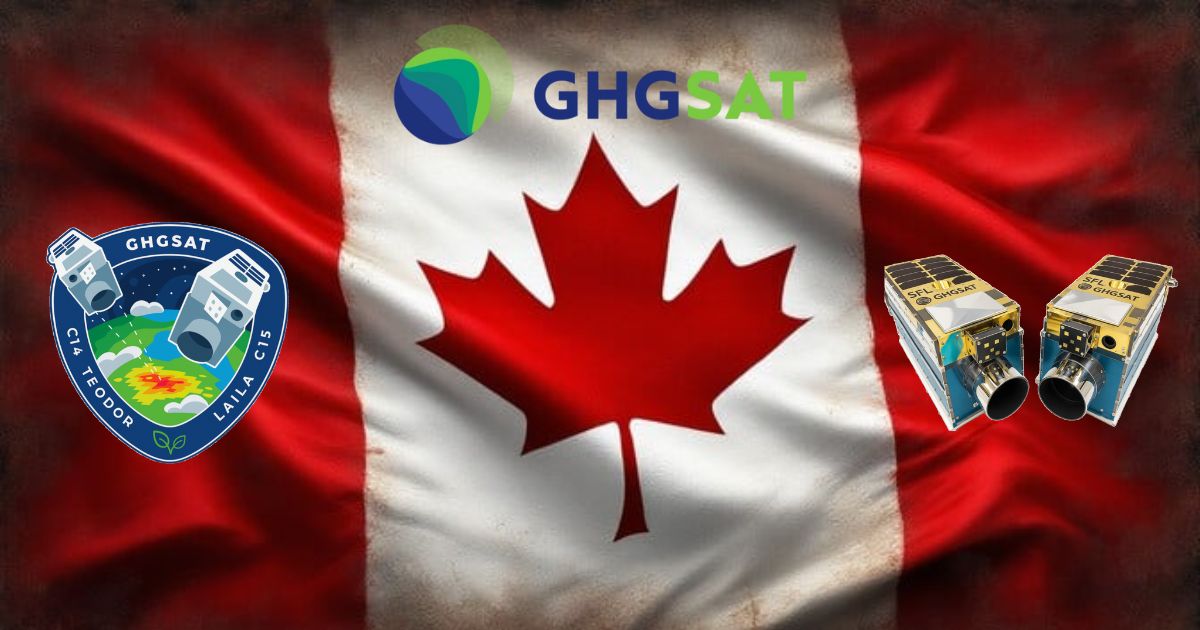
Teodor (C14) & Laila (C15) — Launch Window
Why it matters: More capacity & revisit in asset-dense regions, faster leak detection-to-fix cycle.
Ecosystem: Partners include ABB (sensors), Spire Global (space services), SpaceX (launch).
GHGSat is expanding its mission to expand space-based methane monitoring. The Montreal-based company announced two new methane-monitoring satellites (C14 aka “Teodor” and C15 aka “Laila”), scheduled to launch in fall 2025.
While the specific launch vehicle date is not confirmed, one can assume it will be aboard a SpaceX Falcon 9 during the Transporter-15 rideshare in November 2025 from Vandenberg SFB. The naming of the two satellites is a continuing tradition by GHGSat, who name their hardware after employees’ children to underscore the company’s mission and long-term impact.
The two new satellites will boost capacity in asset-dense regions and extend a fleet already delivering near-continuous, asset-level methane monitoring by leveraging industry partnerships with ABB, Spire Global, and SpaceX. Perhaps one day we’ll see their satellites launch on Canadian rocket made by Reaction Dynamics, NordSpace, or another emerging Canadian rocket supplier.
As of October 20, 2025 GHGSat has launched 14 satellites which track methane emissions from millions of facilities. Most recently they launched the Pierre and Valmay satellites on June 23, 2025. Their first satellite, GHGSat-D (also known as “Claire”) was launched in June 2016. GHGSat aims to have 21 satellites in orbit by 2026.
GHGSat Satellite Launches Updated Oct 25, 2025
Source: Company releases & launch manifests
| Satellite ID | Satellite name | Launch date | Launch vehicle / mission | Launch site |
|---|---|---|---|---|
| GHGSat-D | Claire | 22 Jun 2016 | ISRO PSLV-C34 | Satish Dhawan (India) |
| GHGSat-C1 | Iris | 02 Sep 2020 | Arianespace Vega — VV16 (SSMS rideshare) | Kourou (ELV), French Guiana |
| GHGSat-C2 | Hugo | 24 Jan 2021 | SpaceX Falcon 9 — Transporter-1 | Cape Canaveral, SLC-40 |
| GHGSat-C3 | Luca | 25 May 2022 | SpaceX Falcon 9 — Transporter-5 | Cape Canaveral, SLC-40 |
| GHGSat-C4 | Penny | 25 May 2022 | SpaceX Falcon 9 — Transporter-5 | Cape Canaveral, SLC-40 |
| GHGSat-C5 | Diako | 25 May 2022 | SpaceX Falcon 9 — Transporter-5 | Cape Canaveral, SLC-40 |
| GHGSat-C6 | Mey-Lin | 15 Apr 2023 | SpaceX Falcon 9 — Transporter-7 | Vandenberg, SLC-4E |
| GHGSat-C7 | Gaspard | 15 Apr 2023 | SpaceX Falcon 9 — Transporter-7 | Vandenberg, SLC-4E |
| GHGSat-C8 | Océane | 15 Apr 2023 | SpaceX Falcon 9 — Transporter-7 | Vandenberg, SLC-4E |
| GHGSat-C9 | Juba | 11 Nov 2023 | SpaceX Falcon 9 — Transporter-9 | Vandenberg, SLC-4E |
| GHGSat-C10 | Vanguard (CO₂) | 11 Nov 2023 | SpaceX Falcon 9 — Transporter-9 | Vandenberg, SLC-4E |
| GHGSat-C11 | Elliot | 11 Nov 2023 | SpaceX Falcon 9 — Transporter-9 | Vandenberg, SLC-4E |
| GHGSat-C12 | Pierre | 23 Jun 2025 | SpaceX Falcon 9 — Transporter-14 | Vandenberg, SLC-4E |
| GHGSat-C13 | Valmay | 23 Jun 2025 | SpaceX Falcon 9 — Transporter-14 | Vandenberg, SLC-4E |
Separately, the company secured $47 million CAD in new financing to scale its constellation and analytics platforms. The two moves deepen GHGSat’s capacity to pinpoint industrial methane leaks and expand its global footprint. GHGSat’s satellites pinpoint the source of methane leaks as small as 100 kg/hr, right down to individual equipment.
“The confidence from our investors, demonstrated through this new financing, underscores the growing global demand for emissions monitoring,” said Stephane Germain, CEO of GHGSat in a press release on September 15. “At GHGSat, we are laser focused on building the most operationally useful technology on the market, coupled with advanced analytics capabilities that transform raw data into emissions intelligence.”


