
Maritime Launch Services (MLS) plans to host its first suborbital rocket launch of 2025 between November 18 – 24, 2025 from Spaceport Nova Scotia, minutes away from the small town of Canso, N.S. The mission aims to launch the Barracuda rocket built by Dutch-based T-Minus Engineering.
If all goes according to plan, the Barracuda rocket will cross the Karman line, achieve Mach 6 and deploy a few payloads into Earth’s sub-orbit.
Two Notices To Airmen (NOTAMs) were issued by Transport Canada in November. These NOTAMs are official alerts for pilots about temporary or special conditions that create legal no-fly zones and debris hazard corridors—meaning pilots of aircraft (and drones) can’t operate in the area due to the potential danger of falling debris. The NOTAMs are issued for 10:00 – 14:00 UTC daily between November 18 – 24, 2025.
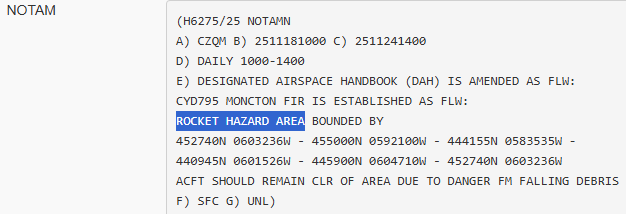
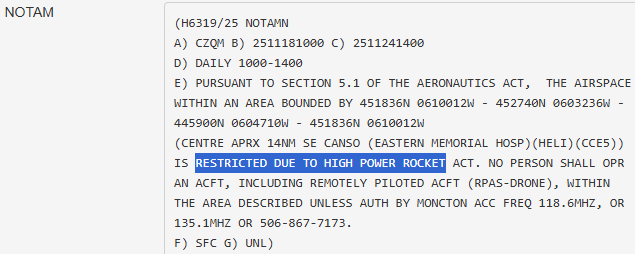
An unofficial source (reddit user) claims that the Barracuda rocket is onsite. While the launch site is prohibited due to “strict regulations,” MLS does have plans to eventually welcome viewers in their eventual launch complex.
So MLS has approval from Transport Canada, the rocket is on-site, and the countdown for launch has begun…but what is the story that got us here? The mission, as with most in the space industry, has gone through quite a few changes since first announced.
Below is a summary of the rocket, the mission, the payload, and why Spaceport Nova Scotia was chosen for the mission.
The Barracuda rocket
The Barracuda rocket is a single-stage, solid-fuel suborbital & hypersonic vehicle that stands approximately 4 metres tall. The booster has a 200 millimetre diameter and a payload compartment measuring 1000 millimetres. Barracuda can carry payloads of up to 40 kilograms to alittudes reaching 120 kilometres (according to MLS).
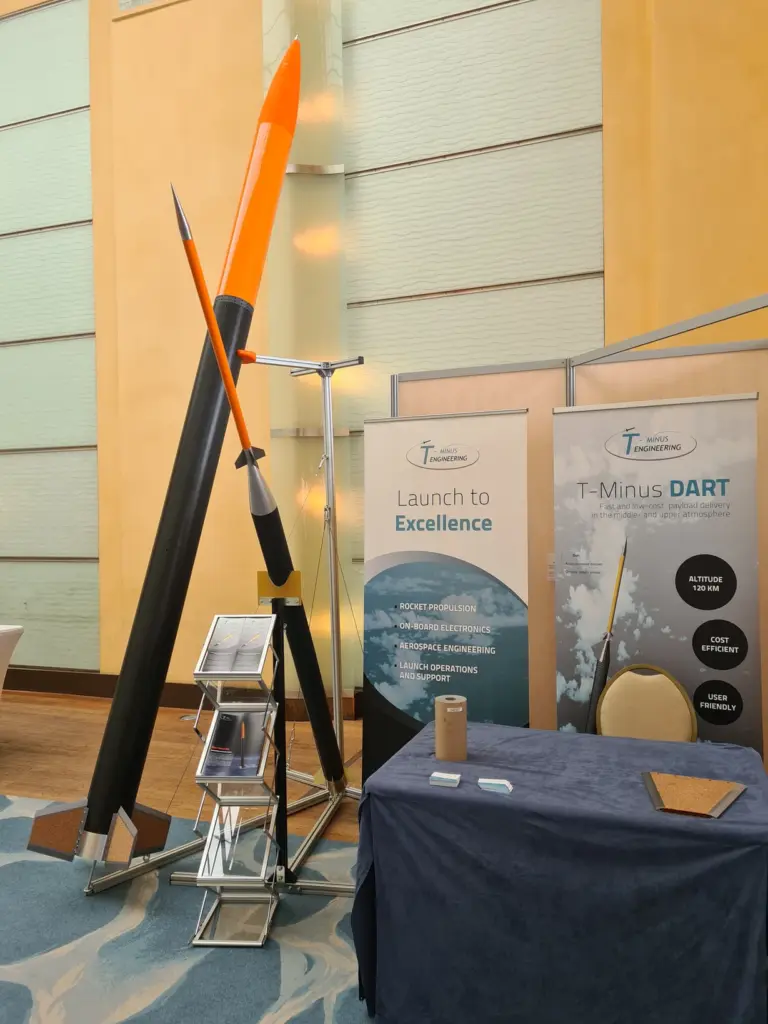
At the reveal of Barracuda during the ESA PAC Symposium in 2022, T-Minus Engineering said that it could carry payloads to 200km apogee, roughly twice the height of the Karman line.
“We look forward to bringing our Barracuda platform to Spaceport Nova Scotia,” said Mark Uitendaal, Director of T-Minus Engineering in a MLS press release. “This launch will demonstrate a fully integrated flight campaign with our Canadian partners and help build momentum for future hypersonic testing programs in Canada.
For this mission Barracuda is expected to reach the Karman line (a first for MLS) and achieve speeds up to Mach 6 (six times the speed of sound). Barracuda is classified as a hypersonic vehicle as it can achieve hypersonic speed (Mach 5 or higher).
Launch timeline & changes
The original plan was to launch two Barracuda rockets containing payloads from Spaceport Nova Scotia in October 2025. That changed to one rocket and a new launch date in November 2025, recently confirmed by NAV CANADA NOTAMs.
You’ve most likely witnessed some sort of delay while following the space industry. Whether it’s a rocket not launching on time because of an errant boat or a company missing a deadline, delays are a sort of “rite of passage” for the industry. See Blue Origin and its New Glenn Flight 2 launch, which has been delayed twice due to weather in November. Launch delays are most often explainable with direct causes outlined, and totally understandable with a little common sense. But then some don’t make any sense and people get upset. All part of the process.
On why the launch was changed from two rockets to one, Canadian space publication SpaceQ queried MLS, to which MLS replied that “T-Minus had not finished manufacturing the second suborbital vehicle yet.” Per an e-mail exchange with spacebahd, MLS shared the reason for the launch delay in which “a European port strike caused a brief delay in receiving the necessary launch cargo.”
Barracuda heads west
This mission will be the first time T-Minus has launched from North America. They have successfully completed launch campaigns across three locations in Europe.
- DART rocket launch Esrange Space Centre in Sweden (April 8, 2025)
- Andoya Space in Norway
- MOD Hebrides in the UK
Missions have enabled testing for radar tracking and supported atmospheric and environmental research missions in the ionosphere. (friendly reminder that Canada’s first satellite in orbit, Alouette-1 studied the ionosphere! Canada was the third country in the world to put a satellite into orbit in 1962, just five years after Russia placed the first satellite, Sputnik into orbit)
MLS shared with spacebahd that T-Minus was “not in a position to share information about payload.” In a shared press release with MLS on June 3, 2025, T-Minus revealed “while most of the payload capacity has already been allocated, limited slots remain available.” They encouraged industry and academic institutions to contact them to propose payloads for the mission.
What we know about the Barracuda payload
Of the payloads included on Barracuda, only one has been publicly shared.
MISSION-03 is a public engagement initiative organized by STORIES of Space. The initiative invited Canadians of all ages to submit written stories and student-designed mission patches to be included alongside other payload items aboard Barracuda. The submissions plan to be stored on micro-SD cards prior to their launch to the great above.
The community-driven campaign sort of speaks to community involvement and just how many parties are involved in order to make a launch happen and have a positive impact. To completely understate it, MLS has gone through a series of assessments, approvals, and lobbying efforts. To give total and absolute credit where it is due, they’re the first private Canadian company to do it.
“…we are incredibly proud of the relationships we have built with our local community, the launch vehicle clients we have partnered with to date, and the many organizations that support safe and successful missions from Spaceport Nova Scotia, including Transport Canada, the Province of Nova Scotia, the RCMP, local EMO, Nav Canada, and Launch Canada,” shared MLS with spacebahd. “This demonstration mission is another important step in strengthening those partnerships as we continue advancing toward orbital launch operations at Spaceport Nova Scotia.”
But why choose Maritime Launch? Why Spaceport Nova Scotia?
Put simply, launch providers cannot meet the demand for placing hardware into space. Launch supply has (literally) sky-rocketed since Elon Musk and SpaceX pioneered the reusable rocket launch industry, with competition from Peter Beck’s Rocketlab and others taking flight. With the combination of launch costs plummeting and satellites getting as small as a loaf of bread, companies can now afford to launch on their own budget. They want in. But there isn’t enough to go around.
There’s a huge wait list for getting hardware onboard a flight and a handful of reliable rocket providers & launch sites. For Canadian companies, 100% of the time they are reliant on a foreign supplier. 100% of the time, they are at the whim of the provider, subject to any changes they make. The most recent victim of this was CalgaryToSpace, the University of Calgary’s student-led organization which was bumped off a SpaceX flight, delaying the launch of its FrontierSat from Fall 2025 to Q1 2026).
Enter MLS, who will not only provide you with the location to launch your own rocket from, but a location that is unique, being only of a few that can achieve a polar orbit. Don’t want to go North? No problem, MLS can guide you towards a southern orbit. The magic with MLS is that it can achieve multiple orbits around Earth—in my extremely orbital-challenged brain, this means twice the customers. International customers you say? That’s like 194 other customers. That’s a lot of launches. A quick note is that MLS currently has an agreement to only launch eight times per year, but I’d assume that cadence would increase with additional lobbying and successful missions.
On polar orbits specifically, this is highly lucrative revenue stream for MLS in light of Arctic security and surveillance. MLS has the theory, and now they need the experience. MLS CEO Stephen Matier has routinely said that the company embraces a “crawl, walk, run” approach. For those watching keenly, it appears that MLS is standing up and beginning to take its first steps after a long eight year crawl.
Looking ahead
It’s been a busy year for MLS, most notably with a recent flurry of funding announcements. Most recently MLS announced $10M in funding from MDA Space to accelerate the development of Spaceport Nova Scotia and its first orbital launch (read about it here). This comes on the heels of a $10M commitment from Export Development Canada, and an earlier $1M funding announcement from Montreal’s Reaction Dynamics (RDX). Part of the funding agreement from RDX included a launch contract, where they aim to launch their Aurora-8 rocket sometime around Q3 2028.
But the momentum doesn’t stop there. The Liberal Party of Canada announced in its 2025 Federal budget that the Department of National Defence will receive $182.5M over three years (beginning 2025-26) to establish a sovereign space launch capability. One can assume that the likes of MLS and other launch competitors (NordSpace) will take a piece of that pie.
To say the least, it’s an exciting time for Canada’s space industry. It’s unclear if a livestream will be available for the Barracuda launch, but you can bet that I’ll be writing on it. Follow me on X for updates, insights, and general amplification of Canada’s space industry.