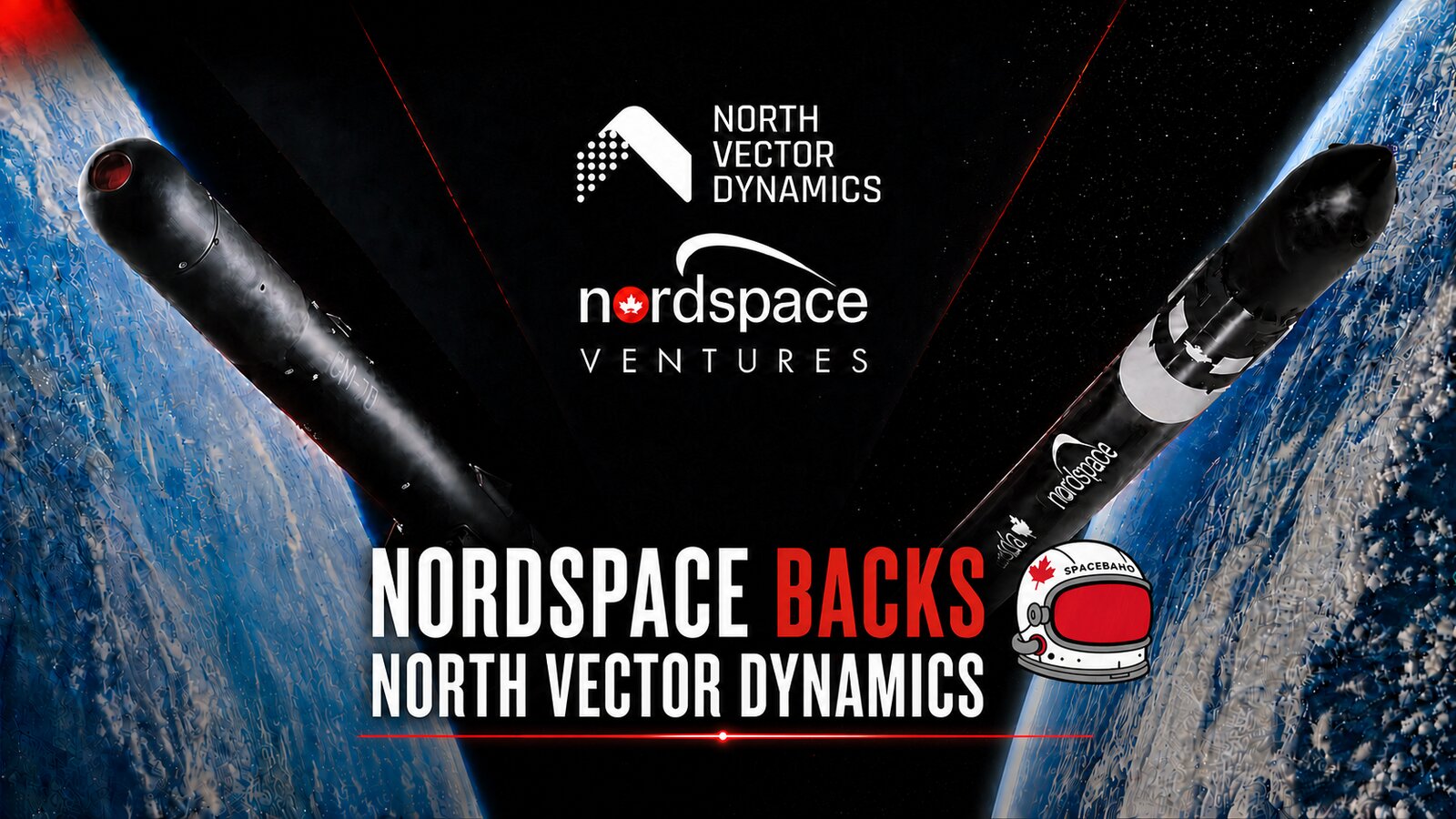
NordSpace Ventures has announced its second publicly disclosed investment, backing Calgary-based North Vector Dynamics (NVD) to advance Canadian defence propulsion and hypersonic technology.
Financial terms were not disclosed. Most importantly, this isn’t simply an announcement that NordSpace wrote NVD a cheque. It offers a glimpse into how the companies plan to align their technologies and infrastructure to build more launch and defence capability in Canada, with the stated goal of keeping the resulting technology, manufacturing and intellectual property under Canadian control.
Different hardware, shared goal
This makes sense for the two companies—NordSpace is developing Canadian-made rocket engines (Hadfield series) and orbital launch vehicles (Tundra, Tundra+, and Tempest, formerly known as Titan). NVD is developing a Canadian-designed precision-guided missile (CM-70 SPEAR), intended to intercept hostile drones. The CM-70 is a short-range counter-drone missile, not a hypersonic weapon. Its hypersonic work is part of a separate, longer-term development roadmap that includes a $4.2-million DRDC aeropropulsion contract.
A key feature of the CM-70 is that it is ITAR-free, meaning it is not governed by the United States’ International Traffic in Arms Regulations. That could simplify procurement, integration and exports by avoiding the need for certain American approvals, although Canadian export controls would still apply.
What the partnership actually covers
Beyond the investment announcement, NordSpace and NVD say they are expanding their technical partnership in two areas.
The first involves applying NordSpace’s propulsion, manufacturing and testing capabilities to NVD’s defence-development roadmap. NordSpace specifically highlighted its patent-pending Hadfield-150 engine, which was developed for the company’s Tundra and Tundra+ orbital launch vehicles. The announcement does not say that NVD will use the Hadfield-150 in a missile or identify a specific system the companies will jointly build.
The second area is hypersonic research. NordSpace and NVD are two of five participants in a University of Calgary-led Hypersonic Innovation Micro-net funded through the Department of National Defence’s IDEaS program. The roughly $1-million project is developing and validating tools for simulating and designing vehicles capable of travelling at least five times the speed of sound. The micro-net is primarily a research and simulation project—not a joint effort to build a hypersonic weapon.
NordSpace says the research will complement its existing SHARP program, which includes the rocket-powered Arrow uncrewed aircraft, the Sabre suborbital rocket and the M2S-HyRock engine. The potential value is the connection between computer modelling, specialized engineering, Canadian manufacturing and real-world testing. However, neither company has announced a specific joint vehicle, test campaign or delivery timeline.
From a Canadian industrial-capacity standpoint, the partnership makes sense. Rocket and missile programs require expensive manufacturing equipment, propulsion-testing facilities and specialized engineering talent that smaller Canadian companies cannot always afford to duplicate.
Sharing those resources could help both companies advance their respective programs faster. For now, however, the announcement is more about aligning their roadmaps than unveiling a finished product. The real test will be whether it leads to jointly tested hardware, Canadian defence contracts or systems manufactured at scale in Canada.
From satellite imagery to missile defence
NordSpace Ventures publicly launched in February 2026 with an investment in Edmonton-based Wyvern, although financial terms were also not disclosed. Wyvern operates the Dragonette constellation of hyperspectral Earth-observation satellites and is developing its next-generation Rosette system. Its sensors capture many narrow bands of light, allowing them to identify materials and conditions that may appear identical in conventional satellite images. The data can support agriculture, wildfire monitoring, mining, environmental protection and defence intelligence.
Together, the investments reveal the broader strategy taking shape inside NordSpace Ventures. Wyvern adds satellite sensing and data capabilities, while NVD adds missile, autonomy and defence-propulsion expertise. NordSpace wants to provide the manufacturing, testing and eventual launch services connecting those technologies.
It is an ambitious end-to-end model. Its success will ultimately depend on whether these investments produce operational hardware, Canadian launches and paying government or commercial customers.
Read the full NordSpace investment announcement.